99%+ Purity
Third-Party Tested
Certificate Every Batch
Ships From USA
Please note
This page is an editorial and informational resource about stability and
storage: what a date printed on a label actually promises, how that date is established from
measurements taken over months and years, and the specific ways the conditions a material is
kept in can quietly make the date untrue.
Nothing is sold on this page. It is a published editorial resource. Nothing
here is an offer, no account can be opened and no order can be placed on this site. We store
nothing, test nothing and assign no dates to anything.
Nothing on this page describes, recommends, compares or makes any claim about any material,
item, treatment or substance, and no such claim is made or implied anywhere on this site.
This resource is written for readers aged 21 and over.
In this guide
What you will find on this page
What a date promises
A retest date and an expiry date are different promises, and both carry conditions in small print. Outside those conditions the date is not shorter. It is simply no longer about the material.
Four things that change it
Heat, moisture, light and oxygen do almost all of the work. The container decides how much of each reaches the contents, which is why the container is part of the claim.
Reading a date off data
The date is where the lower confidence bound meets the limit, not where the average line does. The difference is often a year, and it is the year that gets quietly borrowed.
Excursions and records
A warm afternoon on a loading dock is not a disaster and not nothing. Mean kinetic temperature turns it into a number, and a record turns the number into a decision.
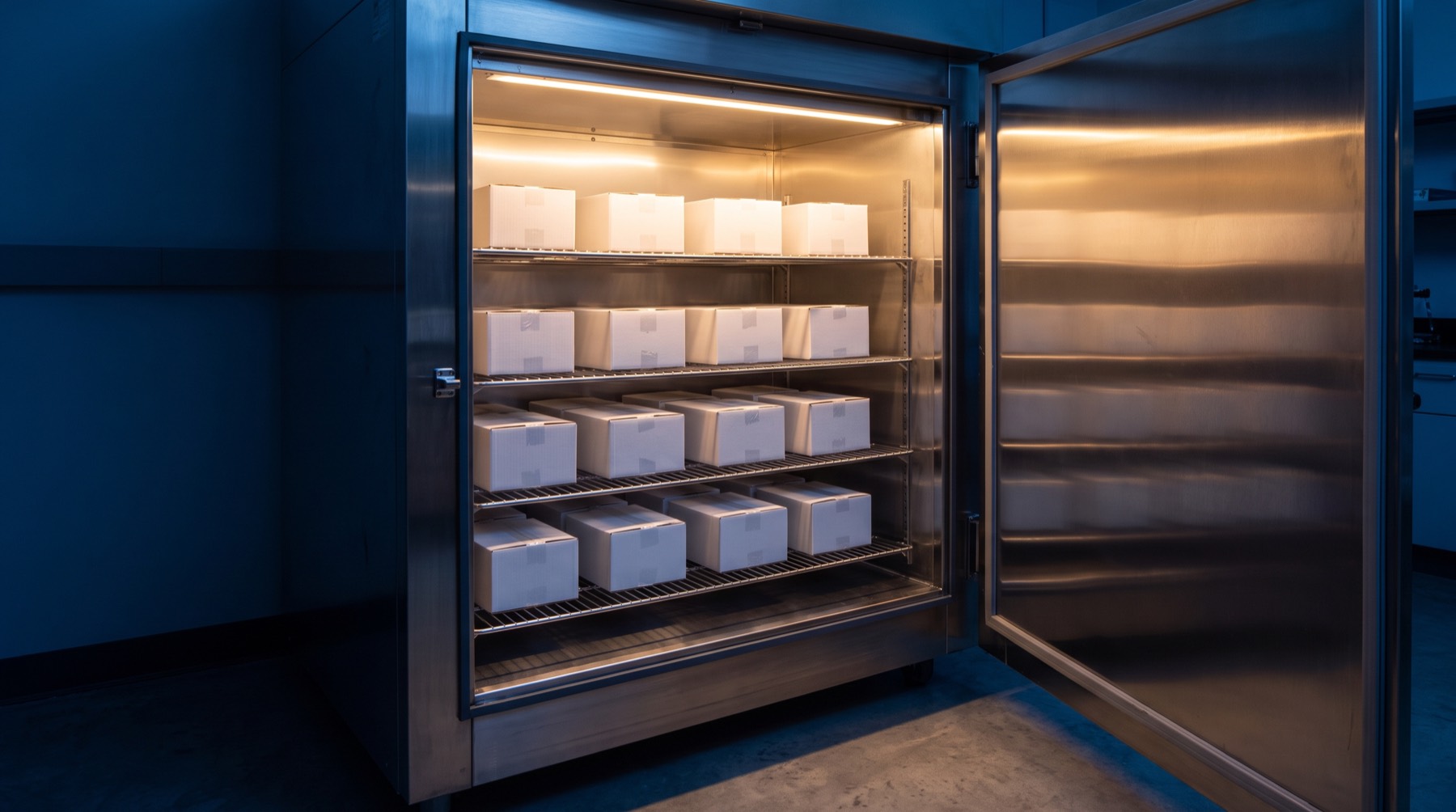
A controlled-condition cabinet holds samples at one fixed temperature and humidity for months or years, and a portion is withdrawn at each scheduled pull point. The date on a label is only as good as the months that were actually spent in here.
Reference guideKingdom Pepts editorial24 September 202619 min read
The date on the label: stability, storage conditions and how a retest date is earned
Every date printed on a container is a prediction. It says that if the contents are kept in a
particular way, they will still meet a particular description on that day. Both halves of the
sentence matter, and only one of them is ever printed in large type. The date is easy to read.
The conditions it depends on are usually a single line in small print, and the description it
promises to meet is usually not on the label at all.
Behind a well-founded date sits a stability study: the same material held under fixed
conditions for a long time, sampled at planned intervals, and measured each time with a method
capable of seeing whether anything has changed. Behind a poorly founded date sits a guess, a
habit, or a figure copied from a similar material. The two dates look identical once they are
printed. The only way to tell them apart is to ask how the date was reached.
A date is a measurement of the past, extended into the future on the condition that nothing
about the storage changes.
What follows is a reference guide to that reasoning: the difference between the kinds of date
in common use, the four agents that change a material while it sits still, how long-term and
accelerated studies are designed and why their results cannot simply be swapped, what a test
method has to be able to do before its results mean anything over time, how a date is read off
stability data honestly, what the container contributes, how to think about a temperature
excursion without either panicking or shrugging, and how a small setting can store materials
so that the dates on them remain true.
It is written for small settings, where there is one refrigerator, one or two people and no
separate stability department. It is deliberately general. It does not describe, recommend,
compare or make any claim about any material, item, treatment or substance, and it never tells
a reader what to do with one.
Three kinds of date, three different promises
In ordinary speech every printed date is an "expiry". In a record they must be kept apart,
because they promise different things and they are handled differently when they pass.
Date
What it promises
What happens when it passes
Retest date
The material is expected to remain within its description until this date, under the stated conditions. After it, the material must be examined again before it is relied on.
Nothing automatic. The material is tested again; if it still meets its description, a new retest date can be assigned. It is a checkpoint, not an end.
Expiry date
The material will remain within its description until this date, under the stated conditions, and is not to be relied on after it.
The material is finished. Retesting it does not extend the date, because the date was set to cover the whole population, not the one container in hand.
In-use period
After the container is first opened, or after the contents are prepared into another form, they remain within description for a stated period.
Whichever comes first, the in-use period or the printed date, governs. It starts on the day of opening, which therefore has to be written down.
The third row is the one most often missing from a record. A sealed-container date says nothing
at all about a container that has been opened, because opening changes exactly the things the
date depended on: the headspace, the moisture, and the number of times the contents meet air.
Every one of the three carries its conditions with it. "Store at 2 to 8 degrees, protect from
light" is not advice attached to a date. It is part of the date. A container kept at room
temperature for its whole life does not have a shorter version of the printed date. It has no
date at all, because nobody ever measured what happens under those conditions.
What changes a material while it sits still
A material on a shelf looks inert. It is not. Almost all of the change that a stability study
is designed to detect is driven by four agents, and it is worth knowing them separately because
each one is controlled by a different part of the storage arrangement.
Heat. Nearly every chemical change runs faster when it is warmer. The
relationship is not linear: a modest rise in temperature can multiply the rate of change,
which is why an afternoon in a hot vehicle can matter more than a month in a cool cupboard.
Temperature is controlled by where the material is kept.
Moisture. Water is a reactant in many of the changes that matter, and a
solvent that lets others happen. Dry solids are frequently stable for years and then change
quickly once they have taken up moisture from the air. Moisture is controlled by the seal of
the container and by how often, and where, it is opened.
Light. Ultraviolet and short-wavelength visible light supply the energy for
reactions that would not otherwise run at room temperature. Light is controlled by the
container material, by secondary packaging, and by whether anyone leaves the box open on a
bench under a window.
Oxygen. Air in the headspace of a container, and air that enters every time
it is opened, supports oxidation. Oxygen is controlled by the fill level, by whether the
headspace is replaced with an inert gas, and again by how often the seal is broken.
A fifth influence is less obvious and just as real: the container itself.
Materials can adsorb onto container walls, react with them, draw components out of a stopper,
or lose volatile parts through a closure that was never completely tight. A stability study
is therefore always a study of the material in a particular container. Transferring
the contents into something else, however clean, leaves the date behind.
Two containers under the same beam. Amber glass absorbs most of the short-wavelength light that drives photochemical change; clear glass lets it through. The desiccant beside them addresses a different agent entirely. Each control handles one of the four, and none of them handles the others.
Long-term and accelerated studies: two questions, not one
A stability study holds samples from a defined batch under defined conditions and pulls
portions for testing at planned intervals. The intervals are fixed before the study starts,
typically at zero, three, six, nine, twelve, eighteen and twenty-four months, then yearly. The
zero point matters as much as any other, because every later result is read as a change from it.
Two families of condition are used, and they answer different questions.
Study
Typical condition
Question it answers
Long-term
The intended storage condition, for example 25 °C and 60 % relative humidity, 5 ± 3 °C, or −20 ± 5 °C.
What actually happens under the conditions the label will state. This is the only study that can support a date directly.
Intermediate
A moderately raised condition, for example 30 °C and 65 % relative humidity.
Whether a change seen under accelerated conditions also appears nearer to real storage, or only at the extreme.
Accelerated
A deliberately harsh condition, for example 40 °C and 75 % relative humidity, usually for six months.
Which changes are possible and how quickly they begin. It is an early warning and a way of ranking risks, not a substitute for time.
For materials stored cold, the "accelerated" condition is usually room temperature, and the
long-term condition is the refrigerator or freezer. The logic is the same: the harsher condition
shows what can happen, the intended condition shows what does.
The temptation is obvious. Six months at forty degrees is cheap and quick; three years at five
degrees is slow and expensive. If the harsh condition could stand in for the gentle one, every
date could be set in half a year. Sometimes it roughly can. Often it cannot, and the next section
is about why.
The Arrhenius shortcut, and where it breaks
The reason accelerated studies are tempting is a well-established relationship between
temperature and reaction rate, usually named after Arrhenius. For a single, simple reaction, the
rate rises exponentially with temperature in a predictable way, and a common rule of thumb says
that each ten-degree rise roughly doubles or triples the rate. On that basis, six months at forty
degrees might be read as the equivalent of several years at twenty-five.
The rule is sound for the situation it describes, and the situation is narrower than it looks.
It holds when one reaction, and the same reaction, dominates at every temperature in the range.
It breaks in at least four common ways.
A different mechanism takes over. At high temperature a reaction that is
negligible at room temperature can dominate, or the reverse. The accelerated study then
measures a change that does not happen in storage and misses the one that does.
The material changes state. A solid that softens, melts, crystallizes into a
different form or loses bound water at forty degrees is a different material at forty degrees.
Nothing measured on it transfers back.
Moisture drives the change, not heat. At high humidity the rate may depend
chiefly on how much water the material takes up, which follows its own curve. Scaling by
temperature alone gives the wrong answer in either direction.
Freezing is not just very cold. Below freezing, water separates out as ice,
concentrating everything else in the remaining liquid. Some changes run faster in a partially
frozen material than in a refrigerated one, which no temperature curve predicts.
Heat compresses time only when heat changes nothing else. That condition is the assumption, and
it is rarely checked.
The honest use of accelerated data is therefore narrow. It shows which changes are possible, it
ranks candidate containers and conditions against each other, and it supports a short
provisional date that is confirmed or withdrawn as long-term data arrives. A date that rests on
accelerated data alone should say so, and it should be treated as provisional until the
long-term study has reached it.
A method that can see change
Here is the failure that makes every other part of a stability study meaningless. The samples
are pulled on schedule, the measurements are made, and every result is the same as the zero
point. The material is declared stable. The true explanation is that the method could not tell
the original material apart from what it had turned into.
A test method used for stability has to be stability-indicating: able to
separate the intact material from the products of its own change, and to measure each of them.
A method that reports a single total, or that lets a changed form appear in the same place as
the original, will report perfect stability for a material that is quietly becoming something
else.
The way this is demonstrated is forced degradation, sometimes called stress
testing. Before the study starts, portions of the material are deliberately damaged: heated,
exposed to strong light, to acid and to base, to an oxidizing agent, to high humidity. The
point is not to learn how the material behaves in storage. The point is to produce the changed
forms on purpose and to confirm that the method can see them, separate them and measure them.
If the method shows the stressed portions as indistinguishable from the fresh one, it cannot be used to support a date.
If the method shows new signals and a corresponding fall in the original, it can.
The stressed portions also show what the likely changed forms are, which tells the study what to look for later.
This is the stability version of a principle that applies to every negative result: a finding
of "no change" is only worth something if the method has been shown able to detect a change
when one is present. Without the stress test, a flat line on a stability chart is not evidence
of stability. It is evidence of a flat method.
Reading a date off the data
Once long-term results exist at several pull points, the date is estimated from them. The
careless way to do it is to fit a straight line through the results and read off where the line
meets the specification limit. The careful way is the same, with one important addition.
The fitted line is an estimate of the average trend. Individual containers, and future batches,
will scatter around it. The date is therefore set where the one-sided 95 %
confidence bound of the line, rather than the line itself, meets the limit. For a
property that falls over time, that means the lower bound. Because the bound widens the further
it is taken from the data, it reaches the limit earlier than the line does, often considerably
earlier.
Reading
Where the date is set
What it implies
Average line
Where the fitted trend crosses the limit.
About half of containers will be outside the limit on that day. It is the date by which the typical container has already failed.
Confidence bound
Where the one-sided 95 % bound of the trend crosses the limit.
The average is expected to remain within the limit with high confidence. This is the defensible reading.
Last good pull point
The latest time at which every result was within the limit.
Conservative and simple, and appropriate when there are too few points to fit anything at all.
The gap between the first two rows is the year that gets quietly borrowed. Nobody writes it
down as a decision. It simply happens when a line is read instead of a bound.
Two further points belong in any honest reading. First, extrapolation beyond
the last real data point should be limited and stated. A date twice as long as the longest
observation is a forecast, not a finding. Second, where several batches have been studied,
their results should only be pooled into one line if a statistical test shows their slopes and
starting points do not differ meaningfully. If they do differ, the date comes from the worst
batch, not the average of all of them.
The container is part of the claim
A date established for one container and closure does not transfer to another. The glass,
the stopper, the seal and the fill level all control how much of each of the four agents
reaches the contents, and a change to any of them is a change to the study.
Headspace. The air left above the contents is a reservoir of oxygen and
moisture. A half-filled container has twice the headspace of a full one, and repacking into
a larger container increases it further. Where the headspace was replaced with an inert gas
at filling, the first opening ends that protection permanently.
Closure integrity. A seal that is intact on arrival can be compromised by
freezing, by repeated temperature cycling that expands and contracts the parts at different
rates, or simply by being opened and reclosed. Closure integrity is tested, not assumed,
wherever a date depends on it.
Light protection. Amber glass, opaque secondary packaging or both. A
container that is amber but kept outside its outer box on a bench under strong light is only
partly protected.
Repeated opening. Each opening admits fresh air and, if the contents are
colder than the room, condensation. A container taken from a refrigerator and opened
immediately draws moisture straight onto the contents. Allowing it to reach room temperature
while still sealed is one of the cheapest controls there is.
For materials that are opened and used repeatedly, it is often better to divide them once, at
the start, into several smaller sealed containers. Each is then opened only when it is needed,
and the contents of the others are never exposed. This practice is sometimes called
aliquoting. It turns one in-use period into several, each starting only when that portion is
first opened.
A data logger records temperature at fixed intervals, whether anybody is watching or not. It is the only instrument that can say what happened on the night the power failed, and the only one that can turn "it was probably fine" into a number.
Excursions and mean kinetic temperature
Sooner or later every storage arrangement has an excursion: a delivery left on a step, a
refrigerator door not quite closed, a power cut overnight. The two instinctive responses are
both wrong. One treats any excursion as ruinous and discards everything. The other treats every
excursion as trivial and records nothing. The useful response is to measure it.
The tool for this is mean kinetic temperature, or MKT. It is a single
temperature that expresses the cumulative effect of a varying temperature history on the rate
of change. Because rates rise exponentially with temperature, a warm period counts for more
than an equally long cool period, and MKT weights accordingly. It is always higher than the
simple average of the same readings.
A record that averaged 6 °C but spent four hours at 22 °C has an MKT noticeably above 6 °C.
If the MKT over a period stays within the labeled storage range, the excursion is usually within what the stability data already covers.
If it does not, the question is whether any stability data exists at the higher condition, and for how long. Accelerated data is useful precisely here.
MKT has one important limitation. It assumes that heat is the only thing that changed. A
freeze, a period of high humidity, or exposure to light is not captured by a temperature
average of any kind, and each has to be judged on its own. A refrigerated material that froze
overnight has not had a "cold excursion". It has had a different event entirely, and freezing
is excluded by many storage statements for good reason.
An excursion that was measured is a decision. An excursion that was not measured is a guess made
on somebody else's behalf.
Storage in a small setting
In a large operation, storage is a qualified room with alarms and a mapped temperature profile.
In a small setting it is a refrigerator, a freezer and a cupboard. The principles are the same,
and most of them cost nothing.
Map the refrigerator once. Place a logger in several positions for a few
days each. The door, the top shelf near the cooling plate and the bottom drawer can differ by
several degrees from each other and from the dial. Keep temperature-sensitive materials on
the shelves that stay within range, and never in the door.
Watch the defrost cycle. Frost-free freezers warm periodically to shed ice.
The cycle is invisible from outside and can raise the temperature near the walls for a
meaningful time. A logger shows whether it matters for what is stored there.
Keep it dry. A sealed secondary container with fresh desiccant protects
against moisture every time the main door is opened, which is a surprising number of times a
day.
Keep it dark. Materials that need protection from light stay in their
outer boxes until they are used, and go back into them afterwards.
Do not overfill. A packed refrigerator does not circulate air, and the
temperature near the back can differ sharply from the front.
Two conventions govern what gets used first. First in, first out uses the
oldest stock first. First expiring, first out uses whatever has the nearest
date first. They agree most of the time. They disagree when a newer delivery carries an
earlier date, which happens more often than anyone expects, and when they disagree the second
rule is the right one.
Retained samples from each batch are held back under the labeled conditions for the full length of the date and some time beyond it. They are the only way to answer a question about a batch after the rest of it has gone.
The record that makes a date checkable
A date is only as good as the record that shows the conditions were met. In a small setting,
a handful of entries is enough, provided they are made at the moment rather than reconstructed
at the end of the week.
On receipt: the date received, the batch identity, the printed date, and the condition on arrival, including whether any temperature indicator in the package had tripped.
On first opening: the date opened, written on the container itself, and the in-use period that now applies.
On dividing: each new container labeled with the batch identity, the date divided, and the earlier of the in-use period and the original date.
On any excursion: the logger record, the MKT if calculated, what was affected, and what was decided.
On retest: the result, the method used, and the new date assigned if one was.
None of these entries takes longer than half a minute. Together they turn a printed date from
something the reader has to trust into something the reader can check.
Eight failures that recur
The storage statement treated as advice. The date is read and the conditions are not, so the material is kept wherever there is room.
An opened container carrying a sealed-container date. The in-use period was never recorded because the day of opening was never written down.
Accelerated data presented as a final date. Six months at forty degrees extrapolated to three years, without the long-term study that would confirm or withdraw it.
A method that could not see change. Every pull point matches the zero point, and nobody ever showed that the method would have noticed a difference.
The line read instead of the bound. A date set where the average trend meets the limit, borrowing a year nobody decided to borrow.
Contents moved to a different container. Clean and convenient, and with no stability data behind it at all.
The refrigerator door. The warmest and most variable place in the unit, used for the smallest containers because they fit there.
An excursion with no record. The power failed overnight, the temperature recovered by morning, and the only evidence is someone's memory that it was probably fine.
A ten-point check of a stability claim
Read any printed date against these ten questions. Each one can be answered from the label,
the documentation and the storage record alone. Any answer that depends on somebody
remembering something is a failed answer.
Is it a retest date, an expiry date or an in-use period, and does the record treat it as that?
What storage conditions does the date depend on, and are they written down where the material is kept?
Does the date rest on long-term data at those conditions, or on accelerated data alone?
How far beyond the longest real observation does the date extend?
Was the test method shown, by deliberate stress, to be able to see the changes that matter?
Was the date set from a confidence bound or from the average line?
Is the material still in the container the study was done in?
If the container has been opened, is the date of opening recorded on it?
Is there a temperature record for the whole storage period, and does it show any excursion?
If there was an excursion, was it assessed, and is the decision recorded?
A date that answers all ten is not thereby guaranteed. It is checkable, which is a different and
more useful property. A date that cannot answer them depends entirely on the storage history
being what everybody assumes it was, and that assumption does not appear anywhere on the label.
The argument of this guide is narrow and it is not a criticism of anybody's measurements. It is
that a printed date is a conditional statement, and that the conditions are the part most often
lost between the study that produced the date and the shelf where it is read. How the date was
estimated, what container it belongs to, what temperature the material actually saw, and whether
anybody wrote down the day it was opened. Those facts are cheap to record at the moment and
impossible to recover later.
Which is why the date on the label is only half of the claim. The other half is how the
container was kept.
Reference guide
Format
Stability & storage
Subject
Nothing is sold here
Purpose
Readers 21+
Written for
More about this resource
Who publishes it, why it exists, and how to reach the editor with a correction or a question about the guide.
This is an editorial resource on stability and storage: what a printed date
actually promises, how long-term and accelerated studies establish it, why a method has to be
shown able to see change before its results mean anything, how a date is read off data
honestly, and how a small setting can keep materials so that the dates on them stay true. It
exists because the conditions behind a date are the part most often lost on the way to the
shelf. The position behind the page is a plain one: a date describes a material kept
in a stated way, and nothing else. Everything that keeps it true happens after the
label is printed.